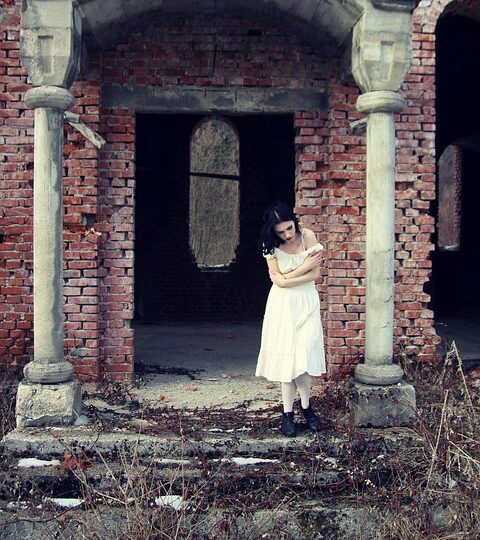

After the man died before atoning for his crimes, he returned from the dead as the vampiric Vrykolakas when his wife did not fulfill his last wishes. The next month was full of terror and hauntings.
Perhaps sunlit Santorini isn't a place people would think vampire-like creatures roamed, although history says otherwise.
From the text of a French priest we have some of the oldest documented written stories about the vampire Vrykolaki from Greek folklore. One of them is the story of a merchant from Patmos, called Patino.
Penitent Vrykol
One of the stories we wrote down came from a Jesuit priest, the cousin of a man who died in Santorini. He was known as a usurer and money lender named Lanettis. He is sometimes given the surname Anapliotis. Lanettis converted in the last year of his life and began to repair the people he had wronged. When he died, he asked his wife to pay off the remaining debts and make amends for her sins if people would come to her.
Ultimately, however, she did not fulfill his last wishes. Instead, she spent alms money on people she liked, not on people in need. Lanettis began haunting his village six weeks after his death as something between a vampire monster and a virulent spirit.
Almost like a poltergeist, Lanettis began to terrorize the villagers. But as Vrykolas, as the Greeks knew these types, they came back dead as.
He was known to tear the bedclothes from sleeping people, wake up priests for matins, empty wine barrels, and generally abuse and terrorize people. It didn't seem to be directed at any specific person and anyone could become a target.
He visited the Mother Prioress of the Dominican monastery, woke her up by rolling her rosary on the floor, and mocked her prayers. She spat in his face and asked him what he wanted. as a farewell gesture, she threw her shoes into a tank of water. Praying alone to drive away the spirit will not bring anything good.
Exhumation and exorcism of Vrykola
This haunting lasted about a month. The desire to atone for his life turned into terrorizing more people in the afterlife. After the woman became speechless for three days after meeting him, the villagers gathered their courage and went to his wife, trying to persuade her to do the right thing and fulfill her husband's last wish.
However, this was not enough, certain rituals had to be performed to ensure that he had wandered into the grave. His body was exhumed and examined. According to the story, his body actually showed no signs of being undead and was badly decayed. However, as a precaution, he was exorcised throughout the day with prayers, after which he was quartered and reburied. This happened not only once, but twice, and he did not stop the haunting until his wife paid off her debt to everyone to atone for her life's sins.
-
The penitent vampire Vrykolakas in Santorini
After the man died before atoning for his crimes, he returned from the dead as the vampiric Vrykolakas when his wife did not fulfill his last wishes. The next month was full of terror and hauntings.
-
The vampire Vrykolakas in Patmos
After terrorizing his village, the vampire Vrykolakas from Patmos, Santorini, was taken to an inhabited island and set on fire. The question is, did it really work?
-
Churel: A vengeful vampire from South Asian folklore
Fueled by anger and revenge, the vampire Churel of South Asian folklore is said to haunt humans to drain their blood as a vengeful spirit raised from the dead.
-
The shoe vampire Vrykolakas from Pyrgos Castle
After a humble life as a shoemaker in Santorini, Greece, a man is said to have returned as Vrykolakas, a vampire from Greek folklore. But in the case of this Vrykolaki, it wasn't devouring human life that kept it alive.
-
Sea Draug: A ghostly fisherman from the Norwegian coast
Believed to haunt the shadowy seas of the north, the Sea Draug is the spirit of drowned fishermen and other unfortunate souls who perish in the waters.
-
Haunted Jane Street Hotel: Echoes of Lost Sailors
After the tragedy and sinking of the Titanic to the bottom of the Atlantic, the surviving crew members were sent to The Jane Street Hotel in New York. According to the stories, they still haunt rooms where the trauma related to their tragedy remains.
-
Soft music haunting Hald Pensionat
Who could be haunting the elderly Hald guesthouse in Mandal? Soft piano music plays in the afterlife and rumors of traces of a Norwegian pirate seem to persist.
-
Mandurugo's vampire bride from Filipino folklore
Hidden among human society, the vampire creature Mandurugo slowly sucks the blood and life of her humble husbands to maintain her eternal youth and beauty.
-
The ghostly guard MS Nordstjernen
The MS Nordstjernen spent decades ferrying passengers north through the Arctic Sea, and although the waters can be brought this far north, it always seemed to reach port unscathed. Some believe it may be Ernst, the ship's ghosts.
-
A cabin in the woods where the forest looks back
There are many strange stories associated with the DNT Flisberget cabin, deep in the mysterious Finnskogen forest, on the border of Norway and Sweden. So much so that it was considered the scariest cabin in the country.
-
Devonshire Park Haunted Theater: The Ghostly Fiddler of Eastbourne
Do any of the musicians from Titanic haunt the Devonshire Park Theater in Eastbourne, England? Who is the person behind the ghost who is said to still play the violin?
-
Mrs. Soria Moria Haunted Villa Fridheim
Soria Moria: Villa Fridheim is often called Soria Moria Castle, the name comes from Norwegian folk tales about a hidden castle where the hero will find a princess. Nowadays, it has also become an expression of expectations towards a wonderful place.
Vampirologists. Franciszek Ryszard
By Light Unseen – Vampires in media and culture
Greek accounts of the Vrykolaki
Image Source: Pixabay.com