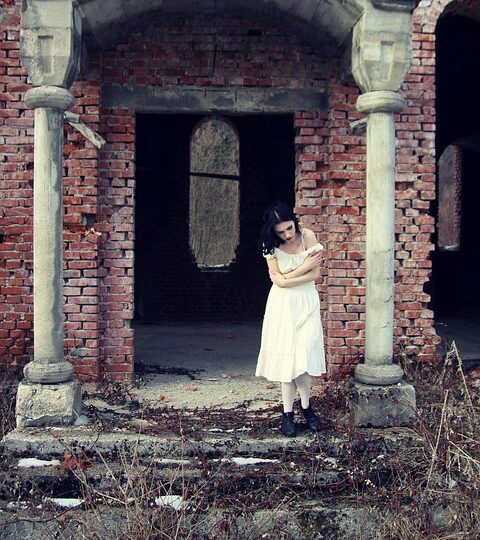

Hidden among human society, the vampire creature Mandurugo slowly sucks the blood and life of her humble husbands to maintain her eternal youth and beauty.
In the terminology of Filipino folklore, Mandurugo is distinguished from the broader category of aswang, a general term for sinister shapeshifters. The name mandurugo itself comes from the root word dugo, which means “blood” in several Filipino languages. Mandurugo literally means “one who deals in blood”.
Mandurugo is typically described as a woman of striking beauty, indistinguishable from others in her community. And unlike many vampire images, she is not seen as a wraith or part of the undead, but rather as a real woman or a being with power.
Beautiful woman in the shadowy
As mentioned, the mandurugo blends in with the rest of human society and mainly attacks adolescent men. She marries again and again to feed her husbands. At night she feeds on her husband, lying next to him in bed while he sleeps. It has a pointed tongue that it uses to pierce and suck out his blood and life.
He also has the ability to shapeshift into a harpy-like creature with wings, and can fly at night and hunt his prey, which has something in common with another vampire creature from Filipino mythology, which we will come back to later.
Her appetites arouse fear and mystery. If a man falls ill suddenly and without explanation, communities whisper that a mandurugo may have visited him at night. If farm animals become delicate or exhausted in a troublesome way, people suspect the same hunger at work.
For protection, some people made a concoction of duhat (Java plum) mixed with ginger, manzanitas bark, yantok, blood and makahiya leaves and used it as an offering to the mandurugo so that it would not harm the household.
Folklore and fear of Filipino shapeshifters
Mandurugo is considered a type of creature of Aswang, a shape-shifting monster in Philippine myths and legends. These creatures have been documented to be the most feared in folklore, and their motives have often caused the most harm.
Husband: Aswang is a general term for various shapeshifting evil and malevolent creatures in Philippine folklore, such as vampires, ghouls, witches, gut suckers, and transforming human-beast hybrids. Spanish colonists noted that the aswang was most feared among mythical creatures in the Philippines, even in the 16th century.
Most stories and legends about Mandurugo can be found in both Tagalog and Bicol traditions, particularly around Capiz on the island of Panay, which seems to be the most famed.
We have documented stories of the Spanish tradition from the 16th century and the stories of Asawang and Mandurugo that were viewed and understood through a Christian perspective and demonology, which has influenced how they are viewed today.
It seems that the lore of Mandrurugo has changed drastically. In the pre-colonial Philippines, the Mandurugo used protective rituals at vulnerable stages of life, such as childbirth. It is also likely that mandurugos were once a type of kinnara or kinnari, fine and pretty winged creatures resembling slender youths. They have wings like birds on their backs, some on their buttocks. In oral tradition, it is believed that Kinari will love and serve with devotion any human who has treated him kindly, and when a human breaks the creature's heart, the Kinari turns into a blood-sucking monster.
The Manananggal vampiric creature attacking pregnant women
As mentioned, the Mandurugo is just one of many vampire creatures with a bird-like appearance. Manananggal is described as an elderly, pretty woman who is able to cut off her upper torso to fly into the night with enormous bat-like wings.
They are definitely similar and have sometimes been used interchangeably in stories. The main difference is who they hunt. Manananggal prey on unsuspecting, sleeping pregnant women in their homes. The myth of manananggal is widely believed in the Visayas regions of the Philippines.
The word manananggál comes from the Tagalog word tanggál, meaning “to remove” or “to separate”, which can literally be translated as “remover” or “separator”. They also utilize their elongated, proboscis-like tongue to suck the fetuses of pregnant women. They also prefer to eat the heart and liver and phlegm of ill people. Folklore also associates this creature with targeting newlyweds, lovers, newborns and sometimes grooms who have been abandoned before marriage.
Traditional practices for killing a manananggal include applying salt, garlic, ash or fire to the lower half, thus preventing the upper torso from reconnecting with it. It is believed that if it does not reunite before sunrise, the creature dies.
A girl with many lovers
One of the most famed stories about a man hunting the Mandurugo vampire is the Tagalog tale of The Girl with Many Lovers.
The adolescent girl, considered the most pretty in the country, was married at the age of sixteen. Even though she came from an unknown place and an unknown family, her beauty captivated everyone. Her husband was adolescent and forceful, but something was wrong. Although there were no obvious signs of disease, it withered within a year and died.
After his death, she remarried, but her second and then third husband suffered the same fate. With all the death following her, suspicions were building around her, even though nothing could be proven.
Her fourth husband, having received a warning, pretended to sleep one night with a knife at hand. At midnight he felt a presence approaching him and then a sting on his neck. He stabbed the creature and heard a screech and the flapping of wings.
The next day, his fiancée was found dead near their home with a knife wound to the chest, all the while being sucked by Manurugo's blood.
-
Mandurugo's vampire bride from Filipino folklore
Hidden among human society, the vampire creature Mandurugo slowly sucks the blood and life of her humble husbands to maintain her eternal youth and beauty.
-
The ghostly guard MS Nordstjernen
The MS Nordstjernen spent decades ferrying passengers north through the Arctic Sea, and although the waters can be brought this far north, it always seemed to reach port unscathed. Some believe it may be Ernst, the ship's ghosts.
-
A cabin in the woods where the forest looks back
There are many strange stories associated with the DNT Flisberget cabin, deep in the mysterious Finnskogen forest, on the border of Norway and Sweden. So much so that it was considered the scariest cabin in the country.
-
Devonshire Park Haunted Theater: The Ghostly Fiddler of Eastbourne
Do any of the musicians from Titanic haunt the Devonshire Park Theater in Eastbourne, England? Who is the person behind the ghost who is said to still play the violin?
-
Mrs. Soria Moria Haunted Villa Fridheim
Soria Moria: Villa Fridheim is often called Soria Moria Castle, the name comes from Norwegian folk tales about a hidden castle where the hero will find a princess. Nowadays, it has also become an expression of expectations towards a wonderful place.
-
Dun Dreach-Fhoula – A blood-soaked, stinking castle
The ruins of Dun Dreach-Fhoula Castle are said to be located deep in the MacGillycuddy's Reeks mountain range in Kerry, Ireland, and are home to the bloodthirsty fairies of the Underworld. The question is whether this is an archaic legend or a contemporary hoax.
-
A woman waiting and haunting the Struten Lighthouse
After being stranded on their diminutive island in the Struten Lighthouse during stormy weather and crashing waves, the woman died of the disease and has haunted her ever since, still waiting for support that never came.
-
The womanizer from room 315 haunted the Sauda Fjordhotel
The once stately Sauda Fjordhotel is said to be haunted by a repentant colonel who took his own life when his womanhood lost the love of his life.
-
The ghost of Captain Smith from the Titanic
After the sinking of the Titanic in 1912, people began reporting seeing the ghost of Captain Smith all over the world. Even after all these years, his death and afterlife are shrouded in mystery, making him one of the most famed ghosts from the Titanic tragedy.
-
Haunted Legends from Wailua, Hawaii
How massive can a haunted area be? Could all of Wailua on the island of Kauai be haunted? The place certainly seems steeped in stories of Night Marches and the procession of the dead making their way down the river to the afterlife.
-
Amalanhig: Immortal hunters of Visayan folklore
Rising from their graves, the vampire Amalanhig of the Philippines pursue your flesh and blood. But where did these creatures come from?
-
Doyle's Pub: The Executioner's Shadow in Phibsborough
Said to be haunted by people from the funeral home that once stood next door, Doyle's Pub in Dublin has more than just live customers drinking drinks.
Mandurugo | Facts, information and mythology
https://solarspell-dls.sfis.asu.edu/mea/wikipedia/wp/v/Vampire.htm
Bicolano Myths: GHOSTS (BIKOLANO MYTHOLOGY)
Mandurugo: a vampire from Filipino folklore
Image Source: Pixabay.com