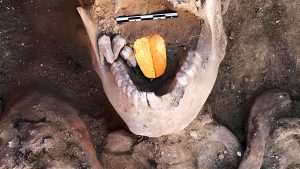


Archaeologists discovered mummies with 13 golden tongues in Oxyrhynchus. Moreover, one of them had two golden tongues at the same time.
Archaeologists discovered 13 mummies with golden tongues and fingernails in a cemetery in the archaic Egyptian city of Oxyrhynchus. Human remains date back to the Ptolemaic period (ca. 304-30 BC), Live learning reports.
In total, archaeologists discovered 52 mummies and 13 golden tongues. Interestingly, one mummy had two golden tongues and the other had nails covered with gold plates.

Archaeologists previously found 16 golden tongues in Oxyrhynchus. Gold was believed to be the “body of the gods”, so the archaic Egyptians placed such tongues in mummies to assist the dead speak in the afterlife.
Salima Ikram, a professor of Egyptology at the American University in Cairo, does not rule out that gold tongues “may have been fashionable in the local embalming house.”
During the excavations, archaeologists also found 29 amulets. Some of them are shaped like scarabs, as well as Egyptian deities, including Horus, Thoth and Isis. Some of them have the shape of several deities together.
The excavations also uncovered wall paintings, including one depicting the tomb's owner named “Wen-Nefer” accompanied by several Egyptian deities.
Another ceiling painting depicts the sky goddess Nut surrounded by stars. There is also a painting of a boat with several deities depicted on it.
As for the images, their quality is truly outstanding and the freshness of the colors is simply astonishing,” commented Francesco Tiradritti, an Egyptologist at the University D'Annunzio in Chieti-Pescara, Italy, on the find.
Image Source: Pixabay.com