

February 22, 2020 “Crazy” by Mike Hughes he towed a homemade rocket into the Mojave Desert and shot into the sky. His goal? To see the flatness of the Earth from space. It was his third attempt and unfortunately it ended tragically. Hughes crashed shortly after takeoff and died.
Hughes' nickname – Crazy Mike – may seem apt. Isn't it crazy to risk your life fighting for a theory that has been disproven? historic Greece?
But Hughes' conviction, while striking, is not unique. In all recorded culturespeople held mighty beliefs that seemed to have no evidence in their favor – these could be called “unusual beliefs.”
For evolutionary anthropologists like methe ubiquity of these kinds of beliefs is a mystery. Human brains have evolved to create precise models of the world. For the most part, we do a pretty good job. So why do people often adopt and develop beliefs that lack mighty supporting evidence?
In a recent review published in the journal Trends in Cognitive Sciences: I propose a basic answer. People come to believe in a flat Earth, ghosts, and microchip vaccines for the same reasons they believe in anything else. Experiences lead them to believe that these beliefs are true.
Theories of extraordinary faith
Most sociologists have a different opinion on this matter. Supernatural beliefs, conspiracy theories AND pseudoscience appeared to researchers to be completely immune to conflicting evidence. Consequently, they assumed that experience was irrelevant to the formation of these beliefs. Instead, they focused on two other explanatory factors.
The first common explanation is cognitive biases. Many psychologists argue that people have mental shortcuts that enable them to reason about how the world works. For example, humans have a tendency to see intentions and intelligence behind random events. These kinds of biases may explain why people often believe that deities control phenomena such as the weather and disease.
The second factor is social dynamics: People hold certain beliefs not because they are sure they are true, but because other people hold them or want to signal to others something about themselves. For example, some conspiracy theorists may hold strange beliefs because they do beliefs come with community devoted and supportive fellow believers.
Both approaches can partially explain why people have unusual beliefs. But they ignore three ways in which experience, in combination with the other two factors, can shape unusual beliefs.
Sharply_done/E+ via Getty Images
1. Experience as a filter
First, I suggest that experience can act as a filter. It determines which unusual beliefs can successfully spread through a population.
Take the flat Earth theory for example. We know with complete certainty that this is a false theory, but it is no more or less wrong than the theory that the Earth is cone-shaped. So what makes a flat Earth so much more effective than this equally incorrect alternative?
The answer is as obvious as it sounds – the Earth looks flat when you stand on it, not cone-shaped. Visual evidence favors one unusual belief over others. Of course, scientific evidence clearly shows that the Earth is round; but it's not surprising that some people prefer to trust what their eyes tell them.
2. Experience as a spark
My second argument is that experience acts as a spark for extraordinary beliefs. Strange experiences such as auditory hallucinations are complex to explain and understand. So people do everything they can to explain them away – and in doing so, they form beliefs that seem appropriately strange.
For this path, a good case study is sleep paralysis. Sleep paralysis occurs in the space between sleep and wakefulness – you feel as if you are awake but cannot move or speak. It's terrifying and enough common. Interestingly, people suffering from this condition usually have the impression that there is a so-called threat agent sitting on their chests.
As a scientist, I interpret sleep paralysis as the result of nervous confusion. However, it is not complex to imagine how someone with no scientific knowledge – that is, almost every person in history – could interpret this experience as evidence for the existence of supernatural beings.
3. Experience as a tool
The third potential route to non-ordinary beliefs is particularly intriguing to me. In many cases, people not only develop unusual beliefs; they develop engaging practices that make these beliefs feel real.
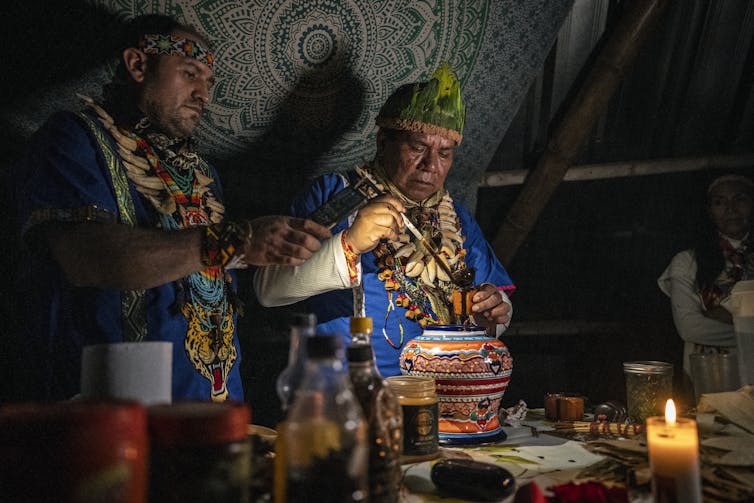
For example, imagine that you are a farmer living in the highlands of Lesotho, southern Africa, where I am conducting ethnographic fieldwork. You've had a series of miscarriages and you want to know why. So you go to a customary healer – she will tell you that you can learn the answers from your ancestors by drinking hallucinogenic infusion. You drink the infusion. Soon after, you start seeing ghosts; they talk to you and explain your misfortune.
Luis Acosta/AFP via Getty Images
It goes without saying that an experience like this can strengthen your belief in the existence of ghosts. Such immersive practices – such as: prayer, ritual dance and religious substance operate – create evidence that makes related beliefs true.
What's next?
Extraordinary beliefs are not inherently good or bad. Especially, religious beliefs they provide meaning, security and a sense of community to billions of people.
However, some unusual beliefs are a source of stern concern: Misinformation about science AND policy is common and extremely hazardous. By recognizing how these beliefs are shaped by experience, researchers can find better ways combat their spread.
But just as importantly, the perspective I'm suggesting can encourage greater compassion and kinship toward people whose beliefs seem very different from yours. They are not “crazy” or dishonest. Like every other person, they think the evidence is on their side.
Image Source: Pixabay.com